
STP vs UTP: When Do You Really Need Shielded Ethernet Cable
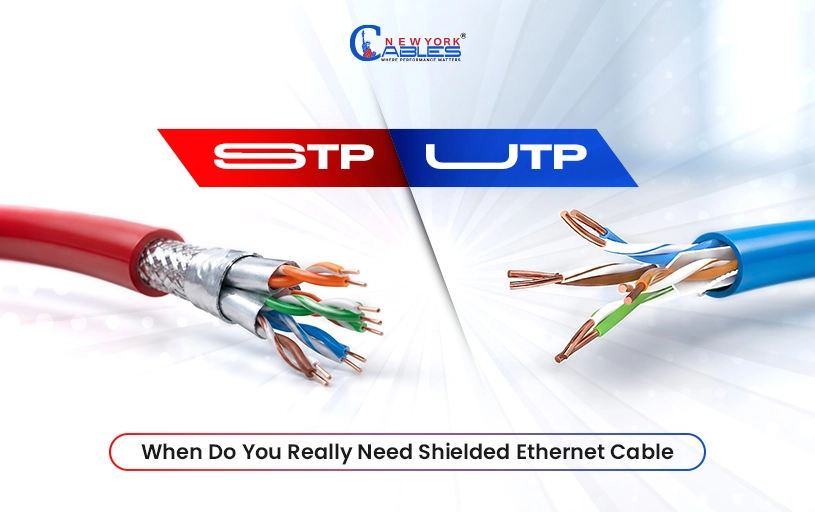
When planning a network installation, one question often arises: Should you use shielded or unshielded twisted-pair cable?
Both options support modern Ethernet speeds. Both can handle Gigabit and even 10 Gigabit performance when properly installed. The difference lies in how they handle electrical interference.
Shielded cable is not automatically better. In many environments, it adds cost and complexity without delivering real benefit. Understanding when shielding is necessary prevents overspending and avoids installation mistakes.
What Is UTP Cable?
Unshielded twisted pair, commonly called UTP, is the most widely used Ethernet cable type in homes and offices across the United States. The twisted pair design itself reduces interference. Each pair of wires is twisted at specific intervals. This twisting cancels out much of the electromagnetic noise that surrounds the cable.
UTP does not include additional foil or braided shielding around the pairs or the overall bundle. It is lightweight, flexible, and easier to terminate.
In typical residential or commercial office environments, UTP performs reliably without added protection.
What Is STP Cable?
Shielded twisted pair (STP) features braided metal or aluminum foil shielding. That shielding may surround individual pairs, the overall cable, or both.
The purpose is to block external electromagnetic interference and reduce alien crosstalk between cables.
Shielded designs are especially useful in electrically noisy environments. However, shielding introduces one important requirement. It must be properly grounded.
If shielding is not properly grounded, it can act like an antenna, worsening interference rather than reducing it.
Where UTP Is More Than Enough
In most buildings, interference levels are moderate. Offices, homes, schools, and retail spaces typically do not generate extreme electrical noise.
WiFi routers, LED lighting, and standard office electronics do not usually require shielded Ethernet cabling.
UTP is sufficient when:
- Cable runs are separated from high voltage lines
- Industrial machinery is not nearby
- There are no large motors or generators close to pathways
- The installation follows proper routing practices
- The cable category meets bandwidth requirements
In these cases, twisted-pair geometry alone effectively handles interference.
UTP also simplifies installation. It is thinner, more flexible, and easier to manage in tight conduits or patch panels. For many structured cabling projects, it remains the practical and cost-effective choice.
When Shielding Becomes Necessary
Certain environments create strong electromagnetic fields. In these situations, shielding provides measurable benefits.
Manufacturing plants often operate heavy motors and conveyor systems. Hospitals may contain imaging equipment that emits electromagnetic noise. Data centers sometimes bundle high-density cables alongside power distribution systems.
In such settings, external interference can raise error rates or reduce signal quality.
Shielded cable helps stabilize performance when:
- Ethernet runs parallel to high-voltage power cables
- Industrial equipment produces continuous electrical noise
- Long cable bundles increase alien crosstalk risk
- High-frequency applications demand tighter signal margins
For example, in a factory floor where motors switch on and off throughout the day, unshielded cable may experience fluctuating noise levels. Properly grounded STP can reduce that instability.
Grounding Is Not Optional
The effectiveness of shielded Ethernet depends on grounding continuity. Patch panels, connectors, and racks must support shield bonding. If only part of the system is shielded, performance may not improve.
Installers must ensure that shielded cable connects to shielded jacks and grounded hardware. Otherwise, the added cost delivers no real advantage.
Improper grounding can also create ground loops. These loops introduce unwanted current flow that affects performance.
Because of this requirement, many installers avoid shielding unless conditions truly demand it.
Performance Differences in Real Use
In low-interference environments, properly installed UTP and STP often perform identically during certification testing.
Cable categories, such as Cat6 or Cat6A, define speed and bandwidth capability, not the presence of shielding. Shielding addresses environmental noise, not raw data rate.
Many enterprise office networks continue using unshielded cable even at 10 Gigabit speeds. The decision should focus on environmental risk rather than marketing claims.
Making the Practical Choice
Choosing between STP and UTP begins with evaluating the installation environment.
If the building contains standard office equipment and properly separated pathways, unshielded cable remains the efficient solution. It reduces installation time and hardware cost.
If the space includes industrial machinery, heavy power lines, or high electromagnetic exposure, shielded cable becomes a protective measure rather than a luxury upgrade.
Ethernet infrastructure should match the environment it serves. More protection is not always better. Correct protection is what matters.
When used with proper grounding and compatible components, shielding can provide stability in demanding conditions. When it is unnecessary, it simply adds complexity.
Understanding that distinction helps installers build networks that are both reliable and cost-conscious.