
Shielded vs Unshielded vs Fiber in High EMI Environments
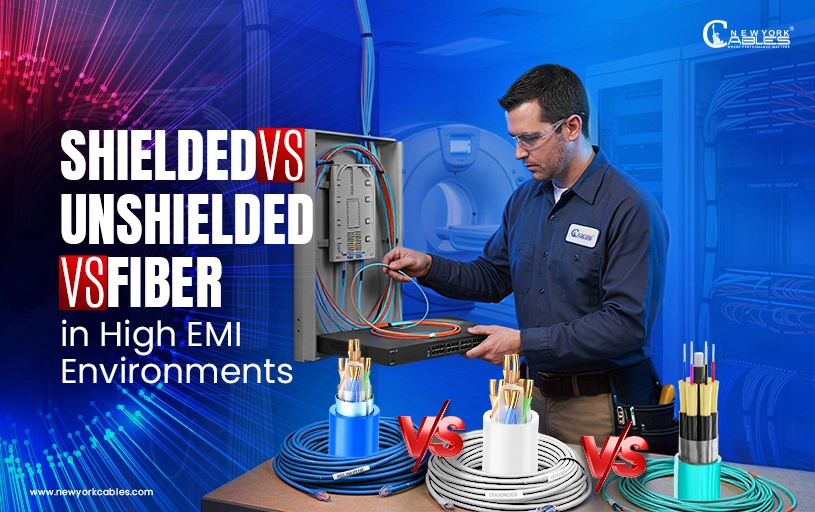
Industrial networks face a different kind of challenge. It is not just distance or speed. The real threat is interference. Electrical noise can distort signals, slow down communication, and cause data loss. This is where the choice between shielded Ethernet, unshielded Ethernet, and fiber becomes critical.
In facilities with motors, welders, or medical systems, cable performance depends on how well it resists external noise. A well planned cabling system can prevent downtime and protect sensitive equipment. The wrong choice can lead to hidden failures that are hard to trace.
Understanding EMI in Real Environments
Electromagnetic interference, often called EMI, is generated by devices that draw high current or switch power rapidly. In industrial spaces, this includes heavy motors, variable frequency drives, welding machines, and large transformers. In healthcare environments, imaging systems and diagnostic machines also create strong interference fields.
These sources release energy that can couple into nearby cables. When this happens, the signal inside the Ethernet cable becomes unstable. Data packets may need retransmission. In critical systems, even small delays can affect operations.
Unshielded cables can handle normal office environments. But in high EMI zones, they may struggle to maintain signal integrity. This is where shielded cables or fiber come into play.
STP vs UTP in Practical Use
Shielded twisted pair cables include a պաշտպան layer that blocks external interference. This can be foil, braid, or a combination of both. UTP cables rely only on twisting to cancel noise.
In environments with moderate interference, a Cat6 Shielded Riser Cable provides a strong balance. It protects signals while maintaining flexibility for vertical runs. For plenum spaces where airflow safety matters, Bulk Cat6 Plenum F/UTP Shielded Solid Copper Cable is often used. It combines fire safety with shielding performance.
For higher data loads, Cat6a Riser Shielded 1000ft Cable offers better headroom. It supports higher frequencies and reduces alien crosstalk in dense cable bundles.
UTP still has its place. It is easier to install and does not require grounding. In low noise areas, it performs reliably and costs less. But once EMI increases, shielded options become necessary.In many commercial installations, the decision between shielded and unshielded cabling depends on interference levels, grounding requirements, and future bandwidth needs. Our expert guide STP vs UTP further explore how both cable types perform in different networking environments and why choosing the correct one affects long-term reliability.
When Fiber Becomes the Only Choice
There are environments where even shielded copper cannot perform reliably. This happens when interference levels are extremely high or when long distances are involved.
Fiber Optic Cables transmit data using light instead of electrical signals. This makes them immune to electromagnetic interference. No matter how strong the surrounding noise is, the signal remains stable.
Fiber is often used in:
- Areas near heavy industrial machinery
- Facilities with high voltage equipment
- Medical environments with imaging systems
- Long backbone runs between buildings
In such cases, fiber is not just an upgrade. It is the only reliable solution.
Grounding and Installation Basics
Proper grounding is what makes shielded cables effective. Without it, the shield cannot drain unwanted noise. Instead, it may reflect interference back into the system.
Grounding must be consistent across the network. Patch panels, connectors, and racks should all be bonded correctly. Using shielded components without grounding creates more problems than it solves.Exploring Troubleshooting Common Networking Cable Issues provide deeper insight into identifying these problems before they affect network stability and performance.
Installers also need to maintain cable integrity. Excessive bending or improper termination can weaken shielding effectiveness. Following installation guidelines ensures that the cable performs as designed.
Cost vs Performance Tradeoffs
Choosing between UTP, STP, and fiber often comes down to balancing cost and performance. Each option serves a different purpose.
UTP is cost effective and easy to install. Best for low interference environments
Shielded copper costs more but protects against moderate to high EMI
Fiber has the highest upfront cost but offers maximum reliability and distance
In many projects, a hybrid approach works best. UTP may be used in office areas, shielded cables in production zones, and fiber for backbone connections.
Making the Right Choice
Choosing between UTP, shielded Ethernet, and fiber depends on the environment and network requirements. The right choice improves performance and long-term scalability.
Evaluate the Environment
Start by identifying interference sources. Look at nearby machinery, power lines, and equipment density. This helps determine whether shielding is required.
Match Cable to Application
Use shielded cables where interference is present. Choose higher category cables for high-speed applications. Select fiber when copper cannot maintain signal quality.
Plan for the Future
Network demands continue to grow. Installing higher performance cables today reduces the need for upgrades later. It also ensures consistent performance as systems expand.A proper cable strategy reduces interference, improves stability, and prepares the network for future growth.
Conclusion
High EMI environments demand careful cable selection. There is no single solution that fits every case. UTP works well in clean environments. Shielded cables provide protection where noise is present. Fiber delivers unmatched reliability when interference becomes extreme.
The key is understanding the environment and matching it with the right technology. When done correctly, the network remains stable, efficient, and ready for future demands.