
Ethernet Cable Qualification vs Certification: What Is the Difference?
Testing an Ethernet installation involves more than checking whether a cable connects two devices. A network connection may show continuity and still fail to support its intended data rate. Similarly, a cable that successfully supports Gigabit Ethernet is not necessarily compliant with the performance requirements of its category.
This is where cable verification, qualification, and certification become important. Although these terms are sometimes used interchangeably, each represents a different level of testing and provides different information about network cabling.
Understanding these differences helps installers, contractors, and network administrators determine which testing method they need, what equipment to use, and when documented test results are necessary. It also prevents a common mistake: assuming that a basic wiremap test proves an entire installation meets industry standards.
Verification, Qualification, and Certification Explained
The three main levels of Ethernet cable testing answer different questions. The appropriate method depends on whether you are checking basic connectivity, evaluating network capability, or proving standards compliance.
1. Ethernet Cable Verification
Verification is the most basic level of testing. It determines whether conductors are connected correctly from one end of a cable to the other.
A verification tester typically checks wiremap, continuity, opens, shorts, and incorrect pin connections. More advanced models can also identify split pairs and estimate cable length.
For example, a straight-through Ethernet cable should connect pin 1 to pin 1, pin 2 to pin 2, and continue in the correct sequence through all eight pins.
However, a cable can pass a basic wiremap test and still have excessive signal loss or crosstalk. Verification confirms connectivity, not transmission performance.
2. Ethernet Cable Qualification
Qualification goes a step further. It determines whether an existing cabling link can support a particular network application or data rate.
A qualification tester evaluates transmission characteristics and compares the results against requirements for supported applications. Depending on the instrument, it may determine whether a link can support 100BASE-TX, 1000BASE-T, or other Ethernet technologies.
For instance, an older installation might have correctly connected conductors but still experience problems when upgraded to Gigabit Ethernet. Qualification testing helps identify whether the existing infrastructure can support the intended application.
However, passing qualification does not establish that the installation complies with every requirement of ANSI/TIA or ISO/IEC cabling standards.
3. Ethernet Cable Certification
Certification is the most comprehensive level of field testing. It determines whether an installed cabling link meets the performance requirements of a specific category or class.
A professional certification tester measures several electrical transmission parameters across defined frequency ranges. It then compares the results against limits established by applicable standards.
For example, a Cat6 installation must meet the relevant Category 6 performance requirements across its specified frequency range, which extends to 550 MHz.
Certification produces a documented Pass or Fail result for each tested link. These reports are particularly important in commercial structured cabling projects, where clients or connectivity manufacturers may require proof of compliance.
What Do Cable Testers Actually Measure?
Different testers measure different electrical and physical characteristics. Understanding these measurements is essential because a cable may pass one test while failing another.
Wiremap
Wiremap checks whether all eight conductors are connected to their intended pins at both ends.
It identifies common wiring problems, including:
-
Open circuits, where a conductor is disconnected.
-
Short circuits, where conductors make unwanted contact.
-
Reversed pairs, where connections are incorrectly arranged.
-
Crossed wires, where conductors terminate on incorrect pins.
-
Split pairs, where conductors from different twisted pairs are combined.
A split pair deserves particular attention. All eight conductors may appear to have continuity, but the original twisted pairs are no longer maintained. This can create substantial crosstalk and cause transmission failures.
NEXT (Near-End Crosstalk)
NEXT measures unwanted signal coupling between wire pairs at the same end of a cable.
When electrical signals travel through one twisted pair, some energy can transfer to an adjacent pair. Excessive coupling interferes with the intended signal and reduces transmission quality.
NEXT is measured in decibels (dB). A higher NEXT value generally indicates better separation between the transmitted signal and unwanted crosstalk.
Insertion Loss
Insertion loss measures how much signal strength decreases as it travels through a cable.
Conductor resistance, cable length, frequency, and construction all influence this measurement. Longer cable runs generally produce greater insertion loss.
Testers report insertion loss in decibels. Lower insertion loss indicates that more of the original signal reaches the receiving end.
Return Loss
Return loss measures signal energy reflected toward the source because of impedance mismatches along the transmission path.
Poor terminations, damaged cable geometry, excessive untwisting, and incompatible components can contribute to impedance irregularities.
Higher return loss generally indicates better performance because less signal energy is reflected.
Other certification measurements include propagation delay, delay skew, power sum NEXT (PSNEXT), attenuation to crosstalk ratio (ACR), and DC loop resistance. Together, these measurements provide a more complete picture of transmission performance.
Ethernet Cable Certification Standards and Listings
Another important distinction is the difference between cabling performance standards and product safety certifications. Both matter, but they evaluate different characteristics.
ANSI/TIA and ISO/IEC Standards
ANSI/TIA-568 is a family of standards covering commercial telecommunications cabling. Its balanced twisted-pair requirements establish performance limits for different cable categories.
ISO/IEC 11801 is an international structured cabling standard that defines performance classes and cabling requirements.
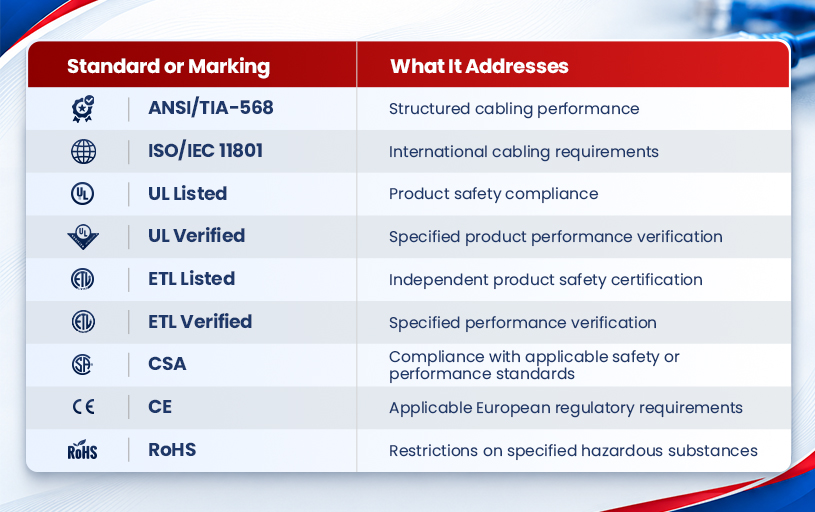
These standards provide the technical limits used during field certification. For example, a Category 6 installation is evaluated against its applicable TIA category requirements, while ISO/IEC uses the corresponding class designation.
UL Listing
Underwriters Laboratories (UL) evaluates products against applicable safety standards. For communications cables, UL 444 is an important standard covering communications cables.
UL markings may also identify fire and installation classifications, such as CMP for plenum spaces and CMR for riser applications.
UL Verified is a separate performance verification program that can apply to communications cable transmission characteristics. Therefore, UL Listed and UL Verified should not be treated as interchangeable terms.
ETL Certification
ETL certification is issued by Intertek, an independent testing and certification organization recognized as a Nationally Recognized Testing Laboratory (NRTL) by OSHA in the United States.
An ETL Listed mark indicates that a product has been independently evaluated against applicable safety standards.
Intertek also offers ETL Verified programs for cable performance. These evaluations can establish whether a cable meets specified transmission performance requirements.
CSA Certification
The Canadian Standards Association (CSA) provides product testing and certification against applicable Canadian, US, and international standards.
A CSA certification mark indicates that the evaluated product meets the requirements identified by the applicable certification. Some marks also indicate approval for both Canadian and US markets.
CE Marking and RoHS Compliance
CE marking indicates that a product meets the applicable European Union requirements for which CE marking is required. It is a manufacturer's declaration of conformity, not a universal third-party quality certification.
RoHS refers to the Restriction of Hazardous Substances Directive. It restricts certain hazardous substances in electrical and electronic equipment within its scope.
Neither CE marking nor RoHS compliance proves that an Ethernet cable passes Cat6 or Cat6A transmission performance tests.
The actual approval depends on the cable construction, intended application, applicable standard, and certification scope. Always verify the manufacturer's documentation and product listing rather than assuming that one marking covers every requirement.
Which Tester Do You Need?
A basic wiremap tester is useful for checking patch cables and identifying incorrect terminations. A qualification tester is more appropriate when determining whether existing cabling can support a network upgrade.
A certification instrument, such as a Fluke Networks DSX CableAnalyzer, is designed for comprehensive field testing. It measures the electrical parameters required by the selected cabling standard and produces detailed reports.
One important point is that using a Fluke tester does not automatically certify a cable. The technician must select the correct test limit, adapters, and link configuration, perform the measurements properly, and save the results.
When Are Certification Reports Required?
Certification reports provide documented evidence that an installed cabling system meets the specified performance requirements.
Commercial installations frequently require these reports during project handover. Contractors may need to submit individual test results for every permanent link to demonstrate that the installation meets the agreed specifications.
Connectivity manufacturers may also require certification reports when customers apply for extended system warranties. The exact requirements depend on the manufacturer's warranty program, approved components, installation procedures, and testing conditions.
A useful report should identify the cable link, selected category, test limit, instrument, test date, and Pass or Fail result. It should also retain individual measurement results rather than providing only a general statement that the installation passed.
Permanent link and channel testing must also be distinguished. A permanent link generally covers the fixed cabling between the patch panel and telecommunications outlet, with a maximum length of 90 meters. A channel includes connecting patch cords and has a maximum specified length of 100 meters under the conventional structured cabling model.
Testing the wrong configuration can produce misleading results because permanent link and channel test limits are different.
For a complete installation, technicians should test every required link, save the results, identify failures, correct the underlying problems, and retest affected connections.
Summary
Verification, qualification, and certification serve different purposes in network testing. Verification checks connectivity, qualification evaluates application support, and certification establishes compliance with defined cabling performance standards.
Similarly, product safety markings and transmission performance standards address different aspects of cable quality. Understanding both helps installers select appropriate testing equipment and avoid relying on approvals that do not cover the performance they need.
A reliable Ethernet installation requires more than a successful connection. It needs correctly installed components, appropriate testing, and documented results whenever the project or warranty requires them.
Frequently Asked Questions
Is a wiremap test enough to certify an Ethernet cable?
No. Wiremap testing confirms conductor connections but does not measure all the electrical parameters required for category certification. A standards-based certification tester is necessary for that purpose.
What is the difference between NEXT and return loss?
NEXT measures unwanted signal coupling between adjacent wire pairs at the same end of a cable. Return loss measures signal reflections caused by impedance mismatches. Both affect transmission quality, but they identify different problems.
Can a cable pass qualification but fail certification?
Yes. Qualification determines whether a link can support a selected network application. Certification evaluates whether the link meets all applicable performance limits of a specified cabling standard.
Does every Ethernet installation need a Fluke test report?
No. Requirements depend on the project specifications, customer expectations, and warranty conditions. Basic residential installations may only require appropriate connectivity and functional testing, while commercial structured cabling projects often require formal certification reports.