
Fiber vs Copper in Modern Data Centers
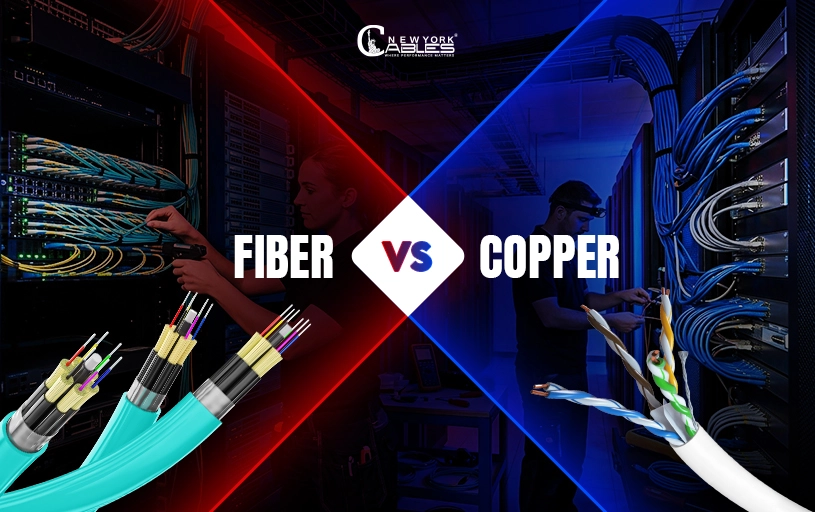
Data centers in 2026 are no longer built on a single medium. The shift toward cloud computing, AI workloads, and edge processing has pushed network design into a hybrid model. Fiber optic cables and copper Ethernet cables now work together, each handling specific roles inside the same infrastructure.
The goal is simple. Deliver high bandwidth, low latency, and stable connections without overspending. To achieve this, engineers carefully decide where fiber makes sense and where copper still delivers value. Understanding this balance is key to building efficient and scalable data centers.
How Data Demands Have Changed
Data traffic today is different from what it was a decade ago. Applications now rely on real time processing. AI clusters move massive datasets between nodes. Storage systems require constant high-speed access. These changes have increased both bandwidth and consistency requirements.
Traditional 1G and 10G networks are no longer enough for many workloads. Data centers now deploy 25G, 40G, and even 100G connections. This shift has forced a rethink of cabling strategies.
Fiber has become essential for high-speed backbone links. At the same time, copper continues to serve short-distance connections where cost and flexibility matter. The result is a layered architecture where both technologies coexist.
Fiber Strengths in Core Networks
Fiber optic cables dominate the core of modern data centers. They transmit data as light, which removes the limitations of electrical signals. This allows extremely high speeds over long distances without interference.
Single mode fiber such as OS2 is used for long-distance links. It supports kilometers of transmission with minimal signal loss. Multimode fiber like OM3 and OM4 is used for shorter high-speed connections within the data center. These cables support high bandwidth while keeping transceiver costs manageable.
Fiber also offers immunity to electromagnetic interference. In dense environments filled with power equipment, this stability becomes critical. It ensures consistent performance even under heavy load.
Another advantage is future scalability. Fiber installed today can support higher speeds later by upgrading transceivers. This makes it a long-term investment for core infrastructure.
Copper’s Role at the Edge
Copper Ethernet cables still play a vital role. They are widely used for short-distance connections between servers, switches, and patch panels. In these scenarios, distances rarely exceed 100 meters, which fits within copper limits.
Cat6 cables are often used for standard Gigabit connections. Cat6a cables support 10GBASE-T and provide better shielding against crosstalk. Patch cables make it easy to connect equipment quickly and replace connections when needed.
Our expert opinion on Why are Copper Cables still an integral part of Data Centers? further explain why copper continues to play a practical role in high-density networking environments.
In many data centers, copper handles top of rack connections while fiber connects racks to aggregation and core switches. This layered use keeps costs under control while maintaining performance.
Building a Hybrid Architecture
A hybrid architecture combines the strengths of both fiber and copper. It is not about choosing one over the other. It is about placing each where it performs best.
In a typical design, fiber is used for spine and aggregation layers. These links carry large volumes of traffic across the data center. Copper is used in leaf layers where devices connect directly to switches.
This approach improves efficiency. High-cost fiber is reserved for critical paths. Cost-effective copper is used where distances are short and interference is minimal. The result is a balanced system that delivers performance without unnecessary expense.
A well-designed hybrid network also simplifies upgrades. Fiber backbone links can scale to higher speeds. Copper connections can be replaced gradually as needed. This flexibility is essential in fast-growing environments.
Cost vs Performance Considerations
Every cabling decision involves trade-offs. Fiber offers unmatched speed and distance but comes with higher initial costs. Transceivers, installation, and maintenance require more investment.
Copper is more affordable and easier to deploy. It works well for short runs and supports power delivery. However, it has limits in bandwidth and distance.
The decision often depends on application needs. High-performance computing clusters benefit from fiber. Standard server connections can rely on copper without performance loss.
Here is a simple way to evaluate both options:
- Fiber optic cables such as OS2, OM3, and OM4 are ideal for long-distance, high-bandwidth links and future scalability
- Cat6 and Cat6a cables are suitable for short-distance connections with reliable performance and lower cost
- Patch cables provide flexibility for quick changes and equipment connections
- Fiber reduces interference issues while copper simplifies installation and supports power delivery
The best choice depends on balancing performance, distance, scalability, and budget. Using fiber and copper where each performs best creates a more efficient and cost-effective network.
Choosing the Right Mix
Designing a data center network requires careful planning. Engineers must consider current needs and future growth. They evaluate bandwidth requirements, physical layout, and budget constraints.
A balanced mix of fiber and copper ensures that the network performs efficiently at every level. It avoids overengineering while still preparing for future demands.
The key is not to follow trends blindly. Instead, decisions should be based on real workload requirements and environmental conditions.
Conclusion
Fiber and copper are not competitors in modern data centers. They are partners. Each serves a distinct purpose within a unified system.
Fiber delivers speed, distance, and reliability for core networks. Copper provides flexibility and cost efficiency at the edge. Together, they create a hybrid architecture that supports today’s data demands and tomorrow’s growth.
By understanding where each technology excels, data center designers can build networks that are both powerful and practical.