
Cat6 or Cat6A for a Smart Home in 2026
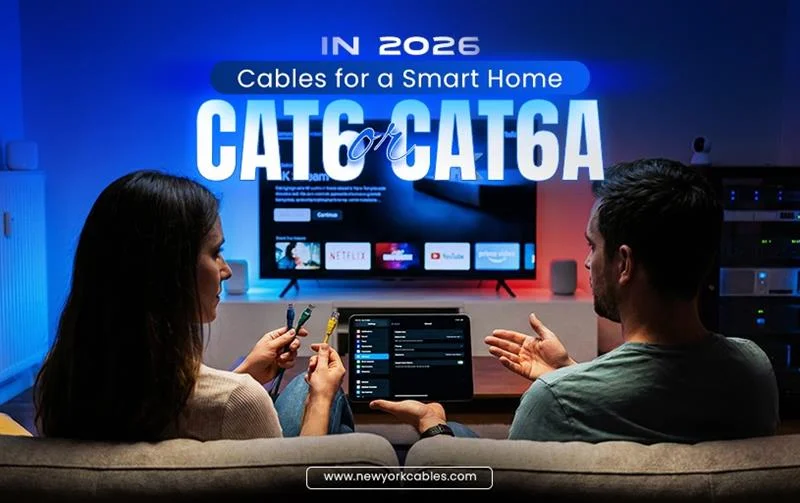
The modern home in 2026 looks very different from a decade ago. Smart TVs stream in 4K and 8K. Gaming consoles demand ultra-low latency. Security cameras record in high resolution around the clock. Voice assistants stay connected at all times. Work-from-home setups rely on stable video conferencing.
All of this traffic moves through one system. Your network cabling. WiFi is important, but every wireless access point, mesh node, and router still depends on wired infrastructure. That makes Ethernet cable a long-term decision, not a temporary one.
When homeowners compare Cat6 and Cat6A, the question often comes down to one simple thing: Is the higher price of Cat6A justified?
To answer that, we need to look at real performance differences and what a smart home truly demands.
Speed and Bandwidth Differences
Cat6 Performance
Cat6 cable supports speeds up to 1 Gigabit per second at 100 meters. It can handle 10 Gigabit speeds, but only up to about 50 meters under ideal conditions. It operates at a 550 MHz bandwidth.
For many homes today, this is sufficient. Internet service providers in most US cities still offer residential plans below 2 Gigabits per second. For short cable runs inside rooms, Cat6 performs reliably.
Cat6A Performance
Cat6A is designed for higher demands. It supports 10 Gigabit Ethernet over the full 100-meter distance. It operates at a 750 MHz bandwidth, which doubles the frequency capacity of Cat6.
The improvement is not only about speed. It is about signal stability. Cat6A has better resistance to alien crosstalk, which becomes important when multiple cables are bundled together.
In a structured wiring panel or attic installation, that extra shielding and separation makes a measurable difference.
What a 2026 Smart Home Really Needs
A smart home is not just about internet speed. It is about internal data flow.
Security cameras stream to local storage devices. Network-attached storage systems transfer large media files. Gaming PCs sync cloud backups. Smart appliances connect continuously.
If a home includes these technologies, then internal bandwidth matters as much as the provider’s download speed.
- Multi-Gig internet service
- 4K or 8K media servers
- PoE security cameras
- Multiple wireless access points
- Smart hubs and automation systems
- A home office with heavy file transfers
Cat6 Ethernet cable can handle many of these tasks today. The question is how long it will remain sufficient.
Distance and Future Expansion
In smaller homes with short cable runs, Cat6 rarely hits its performance limits. Most residential runs stay under 50 meters. In that scenario, even 10 Gig connections can operate reliably.
However, larger homes tell a different story. Longer hallways, detached garages, outdoor camera systems, and central wiring closets increase the total distance.
Cat6A Ethernet cable maintains full 10 Gig performance at 100 meters without compromise. That margin adds long-term flexibility. If future upgrades require faster switches or higher bandwidth devices, the cable will not become the bottleneck.
Replacing in-wall cable is expensive and disruptive. Drywall removal, repainting, and labor costs often exceed the price difference between Cat6 and Cat6A at the time of installation. Planning reduces that risk.
Heat and Power Considerations
Power over Ethernet is now common in smart homes. Cameras, access points, and even lighting systems rely on PoE.
Cat6A typically uses thicker conductors. Thicker copper reduces resistance and allows electrical current to flow more efficiently, lowering heat buildup, especially when multiple cables are bundled together.
As PoE standards evolve and devices demand more power, the size of conductors becomes increasingly relevant. For homeowners installing multiple powered devices, this detail should not be ignored.
Installation Differences
Cat6A is thicker and less flexible than Cat6. It requires more space in conduits and patch panels. Termination can take slightly more effort due to its diameter and tighter twists.
In retrofit projects with narrow wall cavities, Cat6 may be easier to install. In new construction, the difference is usually manageable with proper planning.
Professional installers often recommend planning conduit pathways with future capacity in mind. That allows upgrades without having to open walls later.
Cost Versus Long-Term Value
The price difference between Cat6 and Cat6A has narrowed over the past few years. While Cat6A still costs more, it is no longer dramatically higher than it used to be. The real cost question is not about cable price per foot. It is about lifecycle value.
If a homeowner expects to stay in the property for many years, the extra investment in Cat6A can provide peace of mind. It supports full 10 Gig speeds at standard distances. It improves signal stability. It enhances PoE performance.
On the other hand, if network demands are modest and unlikely to grow, Cat6 remains a solid and reliable option.
Final Verdict
For many 2026 smart homes, the answer depends on scale. Smaller homes with short runs and standard Gigabit internet will perform very well with Cat6. It remains cost-effective and capable for typical use.
Larger homes, high-performance networks, and future-focused installations benefit more from Cat6A. It removes distance limitations. It supports higher bandwidth growth. It strengthens PoE reliability.
Smart home technology continues to expand. Devices multiply each year. Bandwidth demands rarely decrease.
Choosing between Cat6 and Cat6A is less about today’s internet plan and more about tomorrow’s possibilities.
The right decision comes from understanding how your home network will evolve over the next decade. When infrastructure is built with foresight, upgrades become simple. When it is built to the minimum requirements, limitations appear sooner than expected.